
Stride School of Business, India’s first AI-native business school, has announced the launch of its undergraduate business programme, marking a shift in how business education is structured in the AI era. The 3-year, on-campus BBA programme, offered through AICTE-approved campuses, is designed with AI at the core of everyday learning.
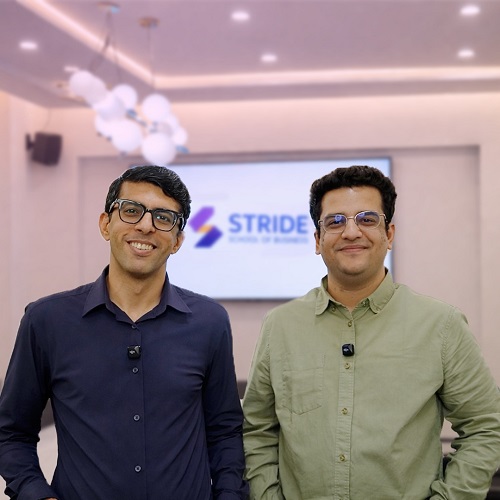 |
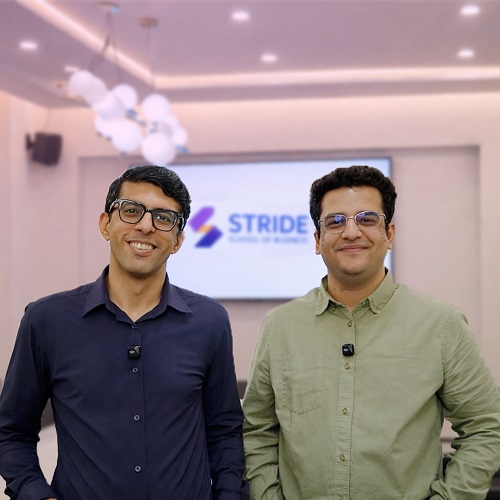
Piyush Nangru, Founder, and Anmol Jain, Founding Director, Lead Stride School Of Business, India’s first AI-native business school
AI has become integral to business operations. According to the World Economic Forum, over 75% of organisations are expected to integrate AI across core business functions. AI is already improving productivity, accelerating execution, and enabling individuals to deliver significantly more output. As a result, the ability to use AI effectively in everyday tasks is becoming a baseline requirement across business roles.
Industry Context: How Companies Are Operating
This shift is already visible across industries, where AI is becoming fundamental to how businesses operate. Organisations are building workflows around AI, using it to drive decisions, execute tasks, and increase speed and operational efficiency. For instance, companies like Genpact are embedding AI across finance, supply chain, and customer operations to automate decision cycles and improve turnaround time.
Similarly, at the enterprise level, Accenture has committed a $3 billion investment in its AI capabilities and plans to expand its AI talent base to 80,000 professionals, indicating a significant shift towards AI-driven delivery models across consulting and operations.
Together, these developments highlight a clear shift in how businesses operate. AI is becoming central to how work is analysed, decisions are made, and execution is carried out, shaping both operations and expectations from business roles.
The Education Gap
AI has become central to how businesses function. However, most BBA programmes still focus on theory, frameworks, and examinations, with limited exposure to practical application. This creates a clear disconnect between classroom learning and what companies expect from graduates.
This gap becomes evident when business graduates enter the workforce. Research from McKinsey & Company shows that nearly 60% of organisations struggle to find talent with AI skills. This trend is also reflected in hiring, where only about 55% of graduates meet employability benchmarks, indicating that many candidates are not fully prepared for job roles.
As a result, many business graduates have conceptual clarity but limited ability to work with AI in real business contexts. When performance increasingly depends on how effectively AI is used for judgment, speed, and execution, this creates a clear gap between academic preparation and workplace expectations.
Stride’s Model: AI at the Core of Learning
Stride School of Business is built to address this gap by making AI not just an additional subject, but a core part of how every subject is taught. From day one, students use AI in their work to analyse, make decisions, and execute across functions such as marketing, finance, operations, and strategy.
Speaking about this shift, Piyush Nangru, Founder of Stride School of Business, said, “Having worked extensively in the higher education space, one disconnect stood out clearly. Traditional BBA programmes continue to prioritise theory, while the way work happens is driven by AI and hands-on execution. This creates a clear gap in readiness. It highlights the need for a more application-focused model. Stride School of Business is built as that response, where AI is integrated into everyday learning, and students build practical capability by working on real business problems using AI tools”
Programme Structure: 3-Year AI-Native BBA
AI is not positioned as a standalone subject. It operates as the underlying system through which students learn, analyse, and execute across every business function.
-
Year 1 — Discover: Students focus on understanding how businesses work. They use AI to analyse companies, work with financials, and create basic content and dashboards. The output is structured learning and first-level application, building clarity across functions.
-
Year 2 — Execute: The shift is to ownership and building with AI. Students design systems, work on growth strategies, and run real business projects, including launching ventures and managing operations with AI support. They begin taking end-to-end responsibility, using AI to improve speed and efficiency.
-
Year 3 — Emerge: The final year focuses on delivering outcomes. Students solve real business problems, work on cross-functional challenges, and build and deploy advanced solutions. They complete 25+ real-world projects, take on internships, and prepare for placements, graduating with a strong portfolio that reflects their ability to perform in real business environments.
Graduates leave with a portfolio that demonstrates execution capability, built through consistent, AI-integrated learning and application.
Learning Model and Faculty
Stride School of Business’s learning model reflects how modern business teams operate, with AI at the core. Faculty members are industry professionals who have built and scaled businesses and actively use AI in their work, bringing current business practices directly into the classroom. This ensures that learning reflects how work is actually done in practice. The programme also follows a selective intake model, admitting only the top 20% of applicants, creating a high-quality peer group that supports stronger learning outcomes.
Examples of Industry Mentors:
-
Radhesh Sirohiya, Co-Founder, Shyle (D2C, Shark Tank India S4, IIT Roorkee)
-
Nitisha Agarwal, Founder, DareAISearch (AI Search, Growth Marketing)
-
Mayank Agarwal, Head of Marketing, The Man Company (Brand Strategy, Ex-Reckitt, MDI Gurgaon)
-
Paurush Mittal, Head of Product Growth, TwinMind (Growth Marketing, Ex-GroMo, IIT Delhi)
In a conversation, Anmol Jain, Founding Director of Stride School of Business, said, “When AI becomes native to how teams operate, the impact is immediate. Work moves faster, decisions become sharper, and execution improves at every level. This is the baseline companies now expect from fresh business graduates. At Stride, this capability is developed early through hands-on work, real business problem-solving, and the consistent use of AI in everyday learning. By the time students graduate, they are already used to taking ownership and delivering outcomes from day one.”
What Sets Stride Apart
-
AI embedded across every subject, shaping how students learn and execute
-
Hands-on learning from day one with real business tasks and data
-
25+ AI-powered real-world projects, building a strong portfolio
-
Industry practitioners as faculty with active business experience
-
Selective intake, admitting the top 20%
-
Campus designed for collaborative, AI-enabled work
-
AI suite with personal MacBook from day one
Vision and Outlook
Stride School of Business, India’s first AI-native business school, is focused on aligning business education with current industry requirements, where AI is part of everyday work. The programme emphasises practical learning through real business tasks, enabling business graduates to gain hands-on experience and become job-ready in line with current industry expectations.
Admissions and Key Dates
Admissions are open for the 2026 cohort through the Stride Business Aptitude Test (S-BAT). Scholarships of up to 100% are available based on merit and performance.
About Stride School of Business
Stride School of Business focuses on building a business education model aligned with how companies operate today, where AI and execution shape everyday work. The 3-year BBA degree is delivered as an on-campus programme through AICTE-approved campuses.
AI is embedded within every subject, becoming a core part of how students learn, analyse, and make decisions across functions. This ensures alignment with real business practice. The institution is built by a team that has worked with over 20,000 students and has prior experience scaling a Series C-funded higher education company.