
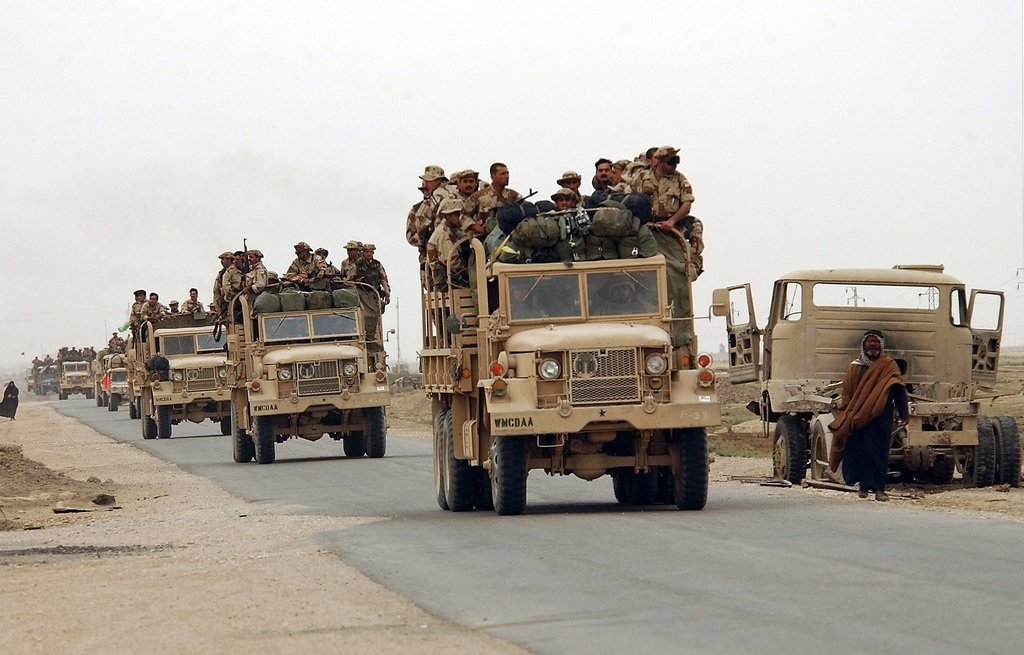
A convoy of Iraqi KM25 (6X6) 2,5000kg cargo trucks filled with Free Iraqi Forces (FIF) Soldiers travels along a highway in An Nasariyah, Iraq, enroute to join up with coalition forces at an undisclosed location, during Operation IRAQI FREEDOM.
Saiyed Zegham Murtaza
October 1, 2026, will be remembered as the day Iran emerged as the ultimate victor in the long saga of American involvement in Iraq. After 23 years of occupation, Washington’s forces have finally departed, leaving behind a fractured nation and a region brimming with uncertainty. What began with the U.S. invasion in 2003 has ended in strategic defeat, as Iraq now tilts decisively toward Tehran. For Iran, this moment is not just symbolic—it is a historic triumph that reshapes Middle Eastern power dynamics.
And finally, after 23 years, the American forces have completely left Iraq. October 1, 2026, marks not just a new dawn in Iraq’s history, but also a decisive moment for Iran. The challenges left behind by Washington may weigh heavily on Baghdad, yet for Tehran, this withdrawal is nothing short of triumph. As the Middle East remains the epicenter of conflicts, the American retreat raises questions — but for Iran, it provides answers in the form of opportunity and dominance.

On March 20, 2003, U.S. troops stormed into Iraq to topple Saddam Hussein. Since then, Iraq has endured endless instability, much of it born from that invasion. While America once deployed nearly 170,000 soldiers at its peak in 2007, the number had dwindled to just 2,500 in recent years, their role reduced to training Iraqi forces. Even so, they remained targets of nationalist Iraqis and Iran’s allies. Now, with their departure, Iran’s influence stands unchallenged.
The withdrawal was celebrated by Iran-backed militias such as Kata’ib Hizbollah and Harakat al-Nujaba, who hailed it as a “historic victory.” Their jubilations reveal the reality: far from laying down arms, these groups now have the freedom to grow stronger, cementing Iran’s grip on Iraq’s future. The Shia majority, empowered since Saddam’s fall, has only deepened Tehran’s sway, proving that America’s war was a strategic blunder that delivered Iraq into Iran’s orbit.
The U.S. sacrificed 4,418 soldiers, spent trillions, and yet exits Iraq weakened, leaving its allies exposed. Saudi Arabia, Kuwait, Qatar, Bahrain, and the UAE now face the sobering truth — America has abandoned them in their hour of need. Washington may claim it acted to protect lives and assets, but the reality is stark: its sphere of influence has collapsed, while Iran’s has expanded.
President Donald Trump’s decision to withdraw may have been framed as pragmatism, but it is Tehran that reaps the rewards. Despite suffering losses in its confrontation with the U.S., Iran emerges with greater regional leverage, while America departs burdened with guilt, strategic defeat, and diminished power. The war brought no gain to Washington, no lasting benefit to its allies — only Israel stands isolated in its support.
The verdict is clear: America leaves Iraq in retreat, while Iran stands tall as the ultimate victor. For Tehran, this is not just a celebration — it is the dawn of a new era of dominance in the Middle East.
- Saiyed Zegham Murtaza is a journalist, columnist, and author known for his incisive writings on politics, society, and minority issues.