
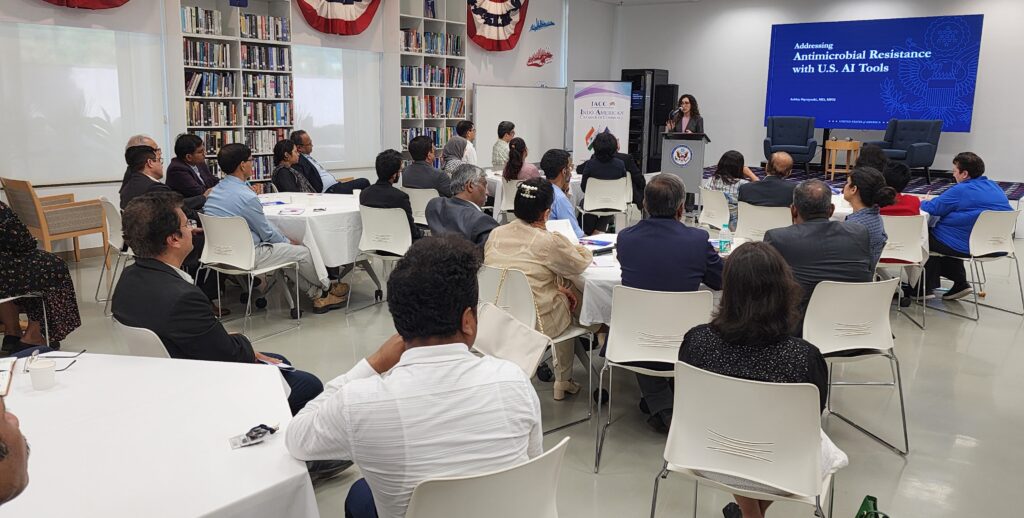
The U.S. Centers for Disease Control and Prevention is partnering with India to explore how AI-driven tools can detect and combat antimicrobial resistance faster.
- By Krittika Sharma
In the fight against antimicrobial resistance, the greatest danger is often what cannot be seen right away. A patient arrives with an infection, and a doctor begins treatment based on the most likely cause. But the bacteria may already be resistant to the standard drugs being prescribed. Confirming that resistance can take days, and while doctors wait for lab results, the infection may continue to spread faster than the system designed to stop it.
That quiet uncertainty is what makes antimicrobial resistance, or AMR, so dangerous. It is not just another disease. It weakens the foundations of modern medicine itself, making ordinary infections harder to treat. It is also the kind of challenge that demands better tools, faster answers, and stronger partnerships.
That is where Dr. Ashley Styczynski comes in. An infectious disease physician and medical officer at the U.S. Centers for Disease Control and Prevention (CDC), Dr. Styczynski is in India through the Embassy Science Fellows Program to examine how the United States can support regional efforts to assess and address AMR. Her work sits at the intersection of global health, health security, and innovation, especially as the United States advances artificial intelligence (AI) as a tool to detect, monitor, and respond to drug-resistant infections more effectively.
Dr. Styczynski’s role in India is to identify gaps and local priorities, and where collaboration with the United States can help make a difference. National action plans are already in place, but the need for faster diagnostics, stronger surveillance, and scalable technology solutions remains urgent.
A global priority
The scale of antimicrobial resistance has pushed it into the front rank of global public health threats. For years, health experts often described HIV, malaria, and tuberculosis as the “big three” because of the number of lives they claimed each year. AMR now belongs in the same category. “In the past few years, as we’ve been able to gather more robust data, we’ve come to appreciate that antimicrobial resistance is also on par, causing more than a million deaths per year,” explains Dr. Styczynski.
But AMR is not only a threat because of the number of deaths it causes directly. It is also dangerous because it erodes the medical tools that many other forms of care depend on. “So much of what we do in modern medicine is dependent on being able to have antibiotics that effectively prevent and treat infections,” she says. “This includes things like routine surgeries, administering chemotherapy, and managing HIV. All of these things depend on having effective antibiotics. If that goes away, then it really undermines a huge portion of what we consider essential health care.”
That is part of what makes AMR such a pressing issue for both India and the United States. It is a health challenge, but also a systems challenge—one that affects preparedness, economic resilience, and public confidence in care.
Race to diagnose faster
One of the hardest things about AMR is that it does not announce itself clearly. A resistant infection can look, at first, like any other infection. The difference often becomes visible only after laboratory testing, and that process takes time.
When someone has a bacterial infection, laboratories typically need to grow the organism and test it against a range of antibiotics to confirm whether the bacterium is resistant. “This typically takes several days, and in the meantime, you have a patient who may not be receiving effective treatment,” says Dr. Styczynski. “This remains an ongoing gap in addressing AMR: having access to rapid diagnostics that can tell you what you are dealing with and what it is susceptible to.”
That diagnostic gap is one reason the United States is investing so heavily in AI-driven approaches. AI is helping scientists and clinicians move from delayed confirmation toward earlier prediction. “In the diagnostic space, AI, especially machine learning, is being used to do things like look at individual bacterial cells and understand their behavior on exposure to antibiotics very early, to predict resistance,” Dr. Styczynski says. “So instead of waiting days, you might be able to get a result in minutes or hours.”
She also points to another practical use of AI: helping clinicians decide whether antibiotics are needed at all. “For example, AI can help identify common characteristics of bacteria to create diagnostics that can answer the question up front: is this viral or bacterial, and do I need to give an antibiotic or not?”
For a country like India, where both scale and speed matter, such advances could make a meaningful difference.
Public health impact
AI’s role in the AMR response does not stop at diagnosis. Dr. Styczynski also describes how AI is being used to monitor infection trends, process whole genome sequencing data, and even accelerate the search for new antibiotics.
“There have been several companies using AI-based platforms for the development of novel antibiotics,” she says. “Some of them can screen millions of compounds in a matter of hours to identify potential therapies.”
Another promising development involves tailoring treatment decisions more closely to the individual patient. “Some researchers have been able to use large language models to develop personalized antibiograms that can stratify the likely risk of different types of resistant infections, so that antibiotics can be prescribed more accurately while a patient is waiting for a definitive diagnosis.”
Even so, much of the work remains in its early stages. “We know that there is often a lag between the development of a technology and its availability in the rural village where it’s really needed,” she says.
That realism is part of what makes her message resonate. U.S. leadership is not only about inventing powerful tools. It is also about building trusted partnerships, supporting systems, and helping move promising technology toward wider public benefit. That includes public-private efforts such as CARB-X, which is an example of how the United States has supported the early development of new diagnostics and therapeutics, including through novel AI applications, with partners in India also receiving support.
India’s role
Dr. Styczynski’s current fellowship focuses on gathering information from more than 80 sources, including stakeholder interviews in Nepal and India, to understand how the United States can support existing national goals. She sees India as especially important because it brings both scientific capability and real-world relevance to the problem. “I think India is well poised to contribute on the technology side as well as on the microbiological side, because some of the pathogens we’re most concerned about tend to come from this region.”
That combination gives U.S.-India cooperation a particular advantage. American leadership in AI tools, data analytics, and moving innovation from concept to implementation can work alongside Indian expertise, data systems, and innovation capacity. “Collaborations between the United States and India can inform these tools in a way that creates the most usable and impactful outcomes,” she says. “There is a lot of microbial nuance in the Indian context that could be leveraged to adapt and tune these models to create more useful outputs.”
She also highlights India’s increasing contribution to global AMR data, including through partnerships with the CDC. India is providing data through platforms like its AMR surveillance systems, which the CDC is a technical partner in supporting. This helps ensure that we are getting robust data to drive solutions.”
For India, the promise of trusted, high-standard U.S. AI frameworks lies in their ability to strengthen domestic capacity while staying grounded in local needs. For the United States, this work reflects something equally important: making America healthier by confronting shared health threats early, investing in innovation, and building partnerships strong enough to keep pace with a changing microbial world.
Courtesy: SPAN