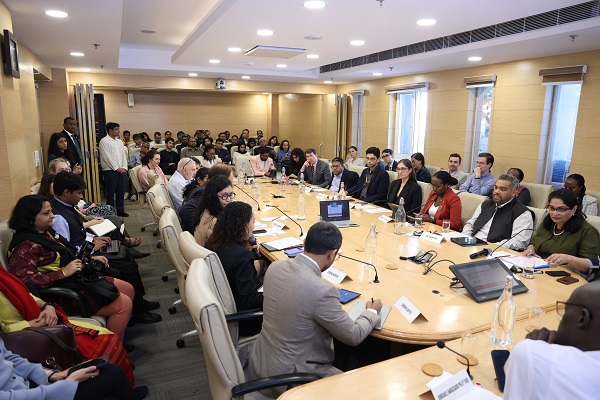
The Global AI for Learning Alliance (GAILA) was formally launched on February 17 on the sidelines of the India AI Impact Summit 2026, bringing together frontier AI firms, governments, EdTech and education leaders to accelerate effective, responsible, and inclusive AI-enabled learning in low- and middle-income countries (LMICs). GAILA will serve as a coordination and collaboration platform to solve the collective action challenge in AI for education. The initiative is co-led by UNICEF and partners, with the Secretariat operated by Dalberg, and initial support from the Gates Foundation.
 |
Frontier AI firms, NGOs, Governments and philanthropic organisations came together to launch GAILA
AI can improve learning outcomes, save teachers time, and expand equitable access to quality education. However, frontier AI investment remains concentrated in the higher income countries, and education systems in the LMICs face persistent barriers: limited infrastructure, affordability constraints, and weak alignment between technology and system needs. Unlocking AI’s potential in these contexts requires coordinated engagement between AI firms and education stakeholders, grounded in national priorities and local realities.
GAILA is working towards an Industry Compact to align AI firms and the global education community around measurable commitments on performance, safety, accessibility, affordability, and relevance. As an initial step, the AI for Learning Industry Call to Action outlines joint commitments across four areas: coordinated investment in shared public goods; improved model performance for education in LMICs; strengthened standards for safety, ethics, and contextual relevance; and expanded affordability and uptake of AI models. By convening diverse stakeholders, GAILA will align incentives and reduce fragmentation in response to national and local priorities, while supporting transparency, accountability, and shared learning across the ecosystem.
The Compact will be co-developed in 2026 with more specific, measurable, and time-bound commitments.
Pia Britto, Global Director Education & Adolescent Development at UNICEF, started the session by saying that, “GAILA is designed to go beyond dialogue. It aims to serve as a bridge from commitment to implementation, supporting collective action that translates innovation into measurable improvements in learning outcomes. Ultimately, GAILA is an invitation to all ecosystem stakeholders to lead together.”
“This ecosystem needs to work better and I am really excited about the progress made in this room,” said Benjamin Piper, Director, Global Education at Gates Foundation.
“At Anthropic, we’re already seeing what happens when AI is built with communities rather than deployed to them through partnerships with governments, educators, and non-profits in places like Rwanda and India,” said Elizabeth Kelly, Head of Beneficial Deployments at Anthropic. “GAILA gives that work a shared framework, and we’re glad to be part of it.”
“We have two key mandates: one is to build the talent pipeline, and the second is to use AI to deliver better educational services, like personalized learning,” said Rohit Tripathi, Deputy Secretary at India’s Ministry of Education. “For both mandates, we need everyone in the room: academia, researchers, evaluators, industry, philanthropy – all of us together.”
Paula Ingabire, Rwanda’s Minister for Communication Technology and Innovation said, “As we join GAILA, we are joining both a vision and a community. A vision because we believe the Global South must write the rules of how AI serves learning, not simply adopt the tools developed elsewhere. And a community, because no country can do it alone.”
A spokesperson from Google and Google DeepMind, “Getting AI in education right requires cross-sector collaboration – with policymakers, educators, researchers and experts. It’s critical to create tools that are genuinely helpful to teachers and students in enhancing learning outcomes. That means using AI backed by research, built responsibly, distributed equitably and grounded in learning science principles.”
The launch event convened senior leaders from across government, AI firms, and education ecosystem actors. Discussions focused on real-world use cases, responsible and scalable deployment, and stronger global coordination across the education ecosystem. The event was co-hosted by Observer Research Foundation and Carnegie India, with participation from organisations including UNICEF, the Gates Foundation, the Government of Kenya, Pratham, Google, Anthropic, and Karya AI.
More information on GAILA is available here. Organisations can review and endorse the AI for Learning Call to Action: www.globalaiforlearningalliance.org/call-to-action-statement
To date, more than 40 organisations have endorsed the Call to Action, including Africodia Foundation, Angaza Elimu, Anthropic, ARED, Boston Consulting Group, BRAC, Brink, Central Square Foundation, ConveGenius, Dalberg, Education Above All, Eedi, EdTech Hub, Eidu, EkStep Foundation, FabAI, FCDO, Gates Foundation, Global Partnership for Education, Global Schools Forum, Gooey.ai, Google, Government of Kenya, Government of Rwanda, Government of Sierra Leone, HundrEd, International Centre for EdTech Impact, International Rescue Committee, J-PAL, Karya, Khan Academy, MakerGhat, OpenAI, Pratham, Project Tech4Dev, Rising Academies, Rocket Learning, ShikshaLokam, SHOFCO, Spix Foundation, Teach For All, The Agency Fund, TUMO, UNICEF, VVOB, and WISE.
About Dalberg Advisors
Dalberg Advisors is a global professional services firm that puts impact at the centre of decision-making.
Founded in 2001, Dalberg Advisors now has over 450+ full-time staff spread across 29 global locations, bringing global perspectives to local solutions for over 1600 clients.
This includes local and international NGOs, governments, financial institutions, philanthropies and business leaders; and entities that sit at the intersections of these organisations.
Link: Dalberg.com | LinkedIn: Dalberg