Narayana Health City Completes 100+ Robotic Cardiac Surgeries in a Single Month
Advanced robotic technology is enabling surgeons to perform complex heart procedures with unprecedented precision and minimally invasive approaches.
Narayana Health City has successfully completed over 100 robotic cardiac surgeries in a single month, marking a significant milestone in advanced heart care. The achievement reflects not only exceptional surgical expertise and clinical precision, but also the seamless integration of cutting-edge robotic technology to deliver consistently strong patient outcomes across adult and paediatric cases.
 |
At Narayana Health’s Robotic Cardiac Surgery Milestone Event (L to R): Dr. Rahul Rao; Dr. Praveen R Tambrallimath; Dr. Raghu MG; Dr. Thiruthani Kumaran M M; Dr. Kiran K
Among the complex procedures performed during the month was the case of a 45-year-old patient who had previously undergone Coronary Artery Bypass Grafting (CABG), commonly known as heart bypass surgery, and later presented with a tumour in the upper chamber of the heart that can obstruct blood flow if left untreated. In patients who have already undergone bypass surgery, reopening the chest through a conventional redo sternotomy can be particularly risky, as the existing grafts (blood vessels surgically connected to reroute blood around blocked arteries) may be damaged during the procedure. In this case, the patient’s earlier bypass grafts were still functioning well, making a traditional surgical approach potentially dangerous. To reduce this risk, the surgical team adopted a robotic assisted minimally invasive approach. The operation was performed through a small incision on the right side of the chest using robotic instruments and high-definition visualisation, allowing access to the heart without reopening the breastbone.
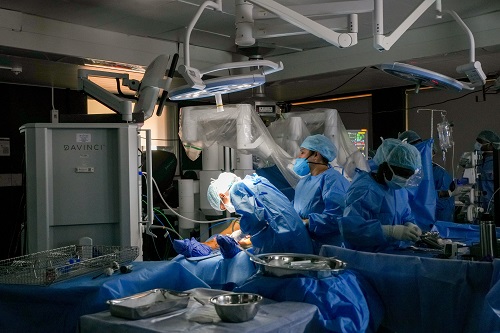 |
Doctors performing robotic-assisted heart surgery at Narayana Health City, showcasing precision technology and advanced cardiac care in action through minimally invasive surgery
Dr. Raghu M G, Senior Consultant – Cardiothoracic Surgery, said, “The patient was supported on a heart–lung machine through peripheral blood vessels, and the procedure was carried out using a specialised technique that allows the heart to temporarily quiver instead of being completely stopped using conventional clamping methods. Using robotic precision, the team accessed the left atrium and successfully removed the tumour while preserving the surrounding heart structures and valve function. The patient recovered well following the surgery and was discharged in stable condition.”
Another notable case involved a 46-year-old patient whose mitral valve had become severely narrowed due to rheumatic heart disease, affecting normal blood flow through the heart. Using a robotic approach, the surgical team replaced the diseased mitral valve with a mechanical mitral valve. The advanced system provided high-definition 3D visualisation and enhanced precision, allowing the team to operate with greater control inside the heart.
Dr. Thiruthani Kumaran M M, Senior Consultant – Adult Cardiac Surgery, explained, “The robotic platform provides exceptional surgical precision, allowing surgeons to operate with greater control while avoiding conventional sternotomy (traditional open-chest surgery through the breastbone). For patients, this approach can translate into less post-operative pain, reduced blood loss, quicker recovery and improved cosmetic outcomes. The procedure was completed successfully, and the patient was discharged in stable condition.”
Another remarkable case involved a 69-year-old woman diagnosed with coronary artery disease along with a rare condition called dextrocardia with situs inversus, where the heart and other internal organs are positioned as a mirror image of the normal anatomy. Evaluation confirmed significant blockages in the heart’s blood vessels along with reduced heart function. Despite the anatomical complexity, the cardiac team performed a robotic-assisted coronary artery bypass surgery. The robotic platform provided enhanced visualisation and surgical precision, which was particularly important in this case because the patient’s heart was positioned on the opposite side of the chest.
Robotic cardiac surgery is transforming the way we treat coronary artery disease. In a recent case involving a 57-year-old gentleman with complex coronary artery disease, our team successfully performed three bypass grafts using robotic-assisted techniques.
With regards to this, Dr. Kiran K, Senior Consultant – Adult Cardiac Surgery, said, “This advanced approach enables us to treat critical blockages with high precision through very small incisions, avoiding the need for a large chest opening or cutting the breastbone. One of the major advantages of this technique is the minimalistic scar, as the surgery is performed through small keyhole incisions without cutting the bone (sternum).
For patients, this translates into less pain, minimal blood loss, faster recovery, and an earlier return to normal life. With advancements in robotic technology and growing surgical expertise, we are now able to offer minimally invasive solutions even for complex coronary artery disease, while replicating the same results as a conventional CABG.”
Dr. Gagan Khullar, Consultant – Adult Cardiac Surgery, shared, “Operating on a patient with dextrocardia and situs inversus presents unique challenges because the heart and surrounding structures are positioned differently from typical anatomy. The robotic platform provides excellent visualisation and precision, allowing us to adapt safely to these anatomical variations. The surgery was completed successfully, and the patient had a smooth recovery and was discharged in stable condition.”
These cases reflect the robust infrastructure and technological integration at Narayana Health’s Cardiology Centre of Excellence. Robotic cardiac surgery requires close coordination between surgical, anaesthesia and technology teams. From pre-operative planning to post-operative recovery, every step is carefully streamlined to ensure precision, safety and faster patient recovery, enabling the centre to scale advanced heart care without compromising on quality.
The milestone also highlights Narayana Health City’s growing reach beyond regional boundaries. Of the patients who underwent robotic cardiac surgery during the month.
35% were from Karnataka
15% from Tamil Nadu
10% from West Bengal
10% from Bangladesh
8% from Jharkhand
8% from Assam
5% from Andhra Pradesh, followed by states of Madhya Pradesh, Bihar, Chhattisgarh, Maharashtra and Tripura. This diverse geographical mix underscores the growing confidence patients across India and neighbouring Bangladesh place in the centre’s advanced robotic cardiac capabilities.
With continued advancements in robotic cardiac surgery, Narayana Health remains committed to making complex heart procedures less invasive and more accessible, while delivering precise, patient-centric care to individuals and families across India and neighbouring regions.
About Narayana Health
Narayana Health, founded by Dr. Devi Shetty and headquartered in Bengaluru, is a leading presence in the global healthcare landscape. As one of the largest healthcare providers in India, Narayana Health operates a comprehensive range of primary, secondary and super-speciality tertiary care facilities across India and the Caribbean. The group’s Centres of Excellence in various medical domains, a team of 18,822 dedicated professionals, including 3,868 skilled doctors and specialists, and a relentless focus on patient well-being and clinical excellence underscore its position as a beacon of hope and healing in the healthcare industry. Narayana One Health (NH Integrated Care) and Narayana Health Insurance are subsidiaries of Narayana Health.
For more information, visit www.narayanahealth.org